The Moon Children An exploration into an enquiry-based curriculum. “I think the moon followed me to nursery.”
- Growing Places

- Mar 2, 2022
- 4 min read

At Growing Places, we believe children are born curious and capable learners.
Our role as educators is to harness this curiosity and support the journey of discovery and wonder.
This project was our first tentative dip into the waters of developing a more enquiry-based curriculum. A curriculum that was not pre-determined or planned by adults, but one that enabled children to explore their own ideas further, to research alongside educators who listened to those ideas and supported the learning though careful posing of questions or setting up rich environments that supported the children’s enquiries.
This project captured the minds of 15 3-4 year old children and an originally sceptical educator, Bridie, in 2017. Bridie McCarroll had worked with children for over 30 years and shared her love of growing, sewing, knitting, baking and creating with the children and adults.
One morning as the children were arriving to nursery two girls Maddisyn and Georgia were gazing out of the window.
Georgina:“The moon is still out!” Maddisyn: “Yes, it’s the moon and I think it followed me to nursery!” Georgina: “It showed me the way to nursery this morning, it followed my Daddies car.”
What an interesting thought!
Luckily, Bridie was there, notebook in hand ready to record this wonderful conversation.
She found it significant and interesting, and the seed of an enquiry was sown!
What Next?
The next step is always, what to do with this interesting statement, how do we acknowledge the children’s thoughts or questions and encourage them to explore it further or elaborate on their thinking and even sometimes challenge their thinking. Bridie shared this small moment in time with her colleagues. They reflected on it sharing their own experiences and knowledge of these children and decided to pose a question to the children the next morning:
“Did the moon follow you to nursery today?”
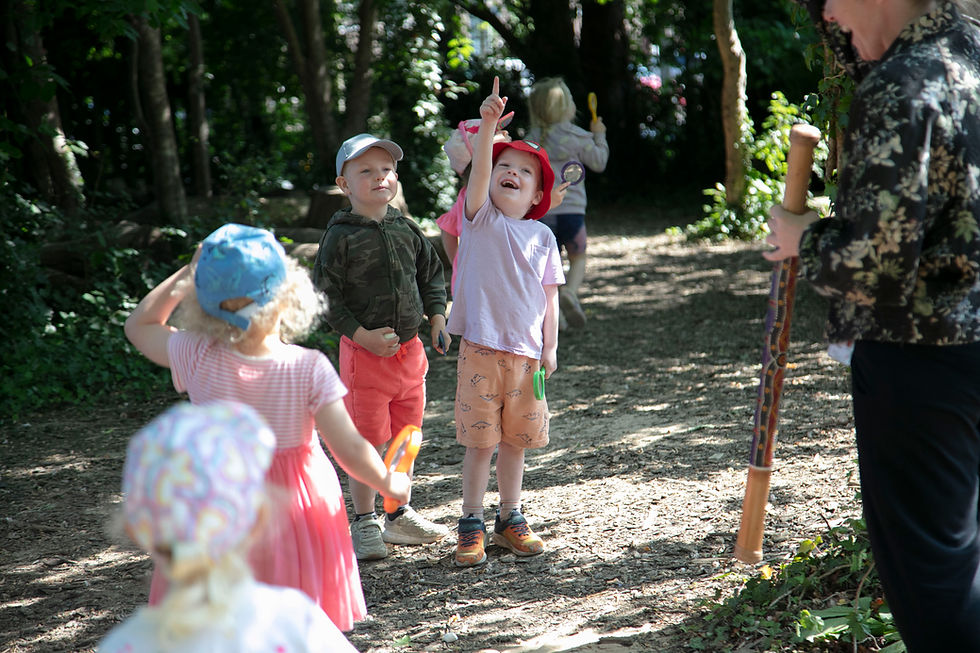
The children were unsure so decided to go outside to check if the moon was there, on spotting it still out Bridie handed them binoculars which enabled them to look at the moon in much more detail...

Maddisyn: “The Moon has got holes in it and it is moon rock. We have one moon; the other half is asleep, that half is hiding behind the black clouds.”
As the children walked back Grace noticed that Talia’s welly boot looked like the moon.
“Wow your welly is the same colour as the moon!”
Talia was wearing sparkly boots and Grace made the link between reflected light of the moon and the sparkle of light on the boots.
Bridie shared this with her colleagues and they decided to create a space for the children to continue their enquiry, we called this our ‘studio’, a space that allows children to be immersed in the enquiry with an abundance of resources for the children to use and access. The children and Bridie would inhibit this space every day over many months as the enquiry moved, evolved and developed.





The children explored the moon, stars and the solar system. Their parents even got involved and would bring interesting objects from home to support their learning.
Bridie used reflection time as a powerful tool to understand the children and their thinking, to ensure she did not lead the journey but supported the children’s exploration and questions.
She always had her camera and notebook to document what was happening, and we are so grateful for this as we have these notes and photos. This enables us as educators to have a richer knowledge about the children, how they were learning and their enquiries.
We have realised that this fascination with the moon was not just a single occurrence, but something that takes place during most autumn mornings, as the children make their way to nursery and noticed the moon. Multiple times we have heard this same question from different children in different settings. We tend to tell children that the moon only comes out at night, but this is not true, and the children are fascinated by this.
Children have lots of questions about the world around them. How? Why? When? Where? They are experiencing these things for the first time and want to understand and make sense of it. It is very easy as adults to give them the answers, but in doing this we limit their learning process.
The journey may not end up answering the original question, but it's the richness in the journey that's important. The connections made, the shared understanding, the skills explored, theories tested and the resilience gained when things don’t go the way you had planned!
Surely these are much richer life lessons for our children than to simply be given an answer?
All of the children, team members and parents, shared the excitement of the Moon project that year and it started us on our own professional journey to find out more about how children learn, so that we can be the best facilitators for them.
Georgina's father, Tom was very impressed by the learning approach...
"Throughout this whole project the staff did a really good job of finding resources to keep the children interested. Emotionally my daughter was so engaged with the project, and I think for them it was that joy of conversation and learning something new with friends, and the joy of telling your parents something they don’t know!"
"There are astrophysicists out there who are still asking questions, we don’t know the final answers and so the nice thing about this kind of project is that there doesn’t have to be an answer, but there can be more questions."
We are so Grateful to Bridie for her time and commitment to this journey into a different style of pedagogy and for allowing our children to have these valuable experiences that we still talk about many years on!
A poem that one of the children composed as part of the Project.
Maddisyn turned to Bridie and said: “I want to do some poet.” and this is what she shared.
The stars glow white and say goodnight. Stars shiver and make it night. They twinkle until they make it night. And then say goodnight.
By Maddisyn, 4 years.
Comments